Water Festival, November 2019
Nov 22nd, 2019 by Jinja
Nov 22nd, 2019 by Jinja
Jun 27th, 2019 by Jinja
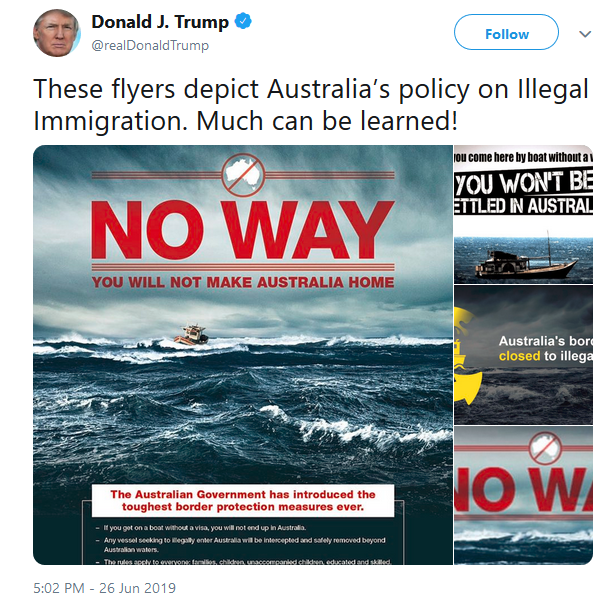
Australia spent $55 million (USD 38 million) to relocate 5 refugees in Cambodia.
Cost effective?
You could have put the refugees up at the Hilton, bought them a business and sent their kids to top private schools for these prices.
Maybe, just maybe, we could be kind instead.

In 2014, then Immigration Minister Scott Morrison infamously clinked champagne glasses with Cambodian officials to celebrate the resettlement deal.
It cost Australia tens of millions of dollars in aid but only ever saw a handful of refugees arrive in Cambodia and even less stay.
The Australian government was berated by rights groups for paying, what critics call, a corrupt and authoritarian government to take refugees it had forced into an offshore processing center on the tiny island nation of Nauru.


May 23rd, 2019 by Jinja
From VICE magazine, a video about how the beach in Cambodia is a great, exotic place to take drugs.
……………………………….

…………………
This is (of course) after VICE’s breathless brothel raid story years earlier. This is right out of the ‘Guns Girls and Ganja‘ playbook.
Folks, you can be seedy right in your hometown.
Some people just need a place to be naughty, but rarely consider that it’s someone else’s home — and that they have their own stories to tell.
Nov 25th, 2018 by Jinja
On social media in the last few weeks, this story has been HUGE:

“Temple kid speaks many languages! But he’s POOR.”
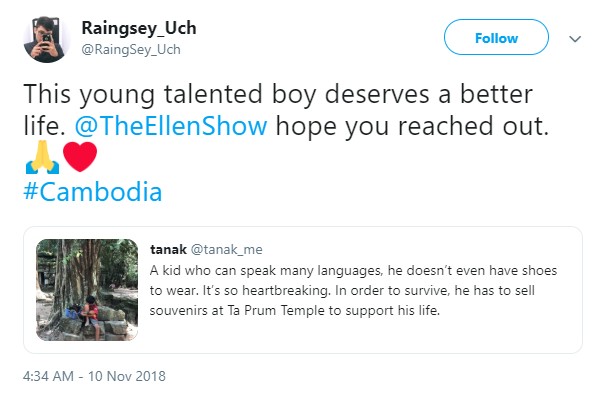
I lived in Siem Reap from year 2000 to 2004. (And was in Tomb Raider before it labeled Ta Prohm the ‘Tomb Raider Temple’.)
The sellers then displayed the same skills as this child. They are versatile and amazing. They are also supported by their families. There are dozens of other children who are just as versatile, but did not get captured on camera. Fifteen languages? I’m sure a survey could find other kids who know ten, eleven languages conversationally – they all swap knowledge.
No child gets all the way into the most famous tourist attraction in the country – Angkor Archaeological Park – without an adult 1) driving them and 2) stocking them up with tourist items to sell. Child vendors are generally supported by an extended family that buys/resupplies their items to sell, provides transport, and replaces them with another child when they get too old and are not ‘cute’. Frequently these kids go to school. Some may duck out because temple selling is more profitable, it’s true.
But just because they’re barefoot doesn’t mean they are destitute. The temples are a highly regulated area and only those who have paid fees/bribes get permitted/selected sell their wares there. If the spaces were truly open to all, tourists would be mobbed by beggars.
On social media, there’s been a lot of attention and hand wringing. (“Please help him, save him”) There are also ethical considerations regarding filming any child so young. I’m not sure that’s good for these youths in the big picture. The tourist who made the viral video? She did not ask for the child’s approval before sharing his picture to the world.
This young vendor is doing way better than lots of other children in Siem Reap, one of Cambodia’s poorest provinces. If there are any positive results from all the media attention, it would be great to see his family get long-term support to take the burden off him specifically at such a young age.
I doubt international media will understand that temple selling is a job and role that will never go away.
In the broader picture? It would be smart to see authorities check to make sure child temple sellers go to school. It’s a half-day in Cambodia.

Postscript: Article added November 17th.
The vendor is going to school, has a family, and is pretty clearly not destitute. Fame can be a burden, let’s see how it works out.
Now, the life of this simple family has been transformed. They have been brought on expense-paid trips to be guests on local television programmes in the capital Phnom Penh. Wealthy businessmen and charities have pledged thousands of dollars, donated new bicycles and toys, and promised to support Salik’s education until he finishes university. There is talk of the family being invited to visit Hong Kong.
… while this family has been the fortunate beneficiaries of the country’s affection and attention, they are just one among hundreds around the Angkor area. And right across Cambodia, children are used as tools to supplement family incomes, often at the expense of their education. While Salik attends school each weekday, he also works several hours every afternoon.
Giving money to children at tourist sites or on the streets can make the situation worse, according to Bruce Grant, UNICEF Cambodia’s Chief of Child Protection.
“Our advice is you don’t give money and you don’t buy from children. I know it’s hard but that’s the right thing to do,” he said, suggesting that visitors should look to only buy from adults, give children pens or books, or seek out vetted social organisations that can properly assist kids in need.
Post-Postscript: Holy cow! This child’s family is $50,000 in debt. That’s more than many farming families earn in a lifetime. Cambodia has a huge consumer debt problem: lenders give loans too easily and citizens are poorly informed of the risks. As an example: Cambodia’s total household debt stood at US$2.9 billion in April 2018 (National Bank of Cambodia), while a decade ago, debt was $200 million. This is the underside of Cambodia’s rapid economic growth – the tide is not lifting all boats, nor ‘trickling down’. Statistically, the broad majority of Cambodians are poorer.
Like many Cambodians whose livelihood depends on selling souvenirs at Angkor, the family has found themselves in debt, Mann says.
“We bought a plot of land and built a house, but it became more and more difficult to make enough money. I have weeks where I don’t earn a single dollar, yet I still have to pay the authorities US$5 a month to be allowed to sell souvenirs near the temple,” she says. Mann says the family has racked up debts of US$50,000, making it impossible to send her boys to a private school so they can improve their language skills.
“At some point we had to borrow money from a private lender, but the interest was very high [15 per cent to 20 per cent].” Medical bills for her ailing mother and the expense of sending her to Thailand for treatment got them into a deeper hole.
“Right now I still owe private lenders US$30,000 and the bank over US$20,000. The bank now wants me to pay US$700 a month. If I don’t pay it back on time, they will add the interest that I still owe them to the loan. I don’t want that to happen,” she says.
Poverty and debt: the true story of the multilingual Cambodian boy https://www.inkstonenews.com/society/poverty-and-debt-true-story-multilingual-cambodian-boy-thuch-salik/article/2175382
Post-Postscript:
Despite Salik’s success, concerns remain for welfare of Cambodian children working in tourism
The viral story of Thuch Salik, the talented multi-lingual boy selling souvenirs around Angkor Wat, has thrown the spotlight on the plight of working children in the province and across the country.
Feb 26th, 2018 by Jinja
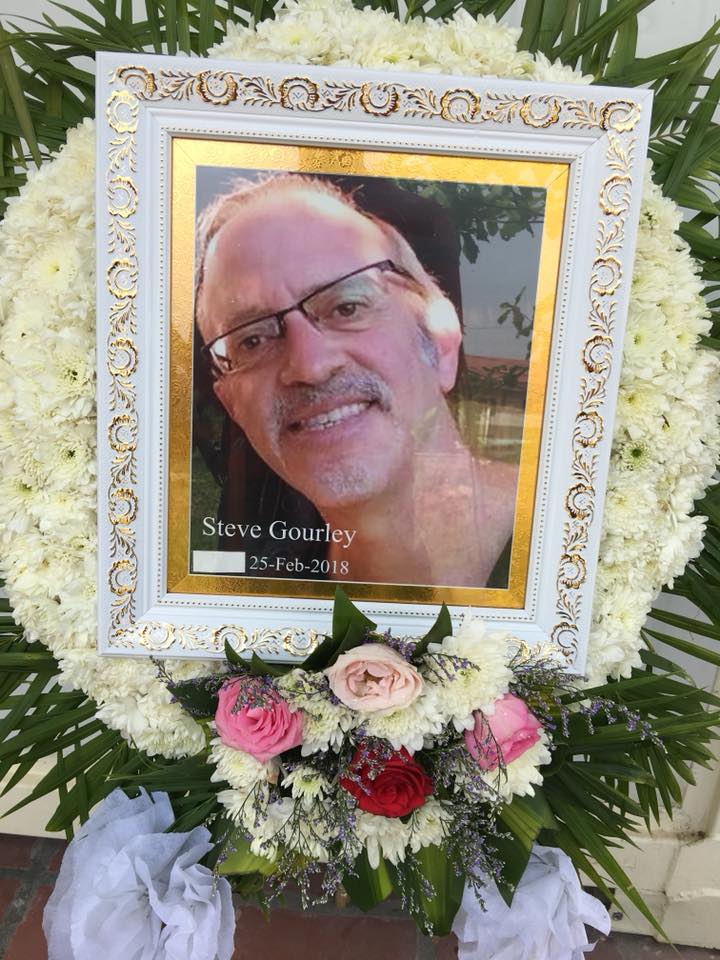
[Above: memorial at Wat Teuk Thla, Phnom Penh. It is open to the public.]
Steve Gourley (51) has passed.
He had been convalescing from head trauma from a moto accident in Phnom Penh in 2017. He had the good fortune to have a good medical cover, and had initially begun recovery in Bangkok.
Fluent in Khmer, he is remembered as an ardent child rights advocate, human rights advocate, and deeply supportive person. He had lived in Cambodia since shortly after studying Khmer at the Southeast Asian Summer Studies Institute (SEASSI) (1995 class). Steve was from Stockton, California and had worked with the Khmer community there. We bonded over sharing notes on the expat community; him for Stockton, me for Long Beach.
If you didn’t go crazy, you survived SEASSI. (Maybe we did both.) At one point Steve was absent from class three days and I remember loading up on ‘flat food’ (fruit roll-ups, pop tarts, cheese slices) to slide under his door. We had the honor of studying with Ketja Soeur, who had joined SEASSI via a Fulbright grant. He remained in touch until she passed away due to sudden heart failure in year 1999.
When I arrived in Cambodia in May 2000, he met me with his ‘Khmer Mom’ who he’d bonded with after the 1997 crisis. He’d gained remarkable fluency in the intervening years, and this served him well as he dug deep into child rights issues, with groups such as World Vision and LICADHO among many others. Every time I saw him he had a new assignment, new report, new area to research.
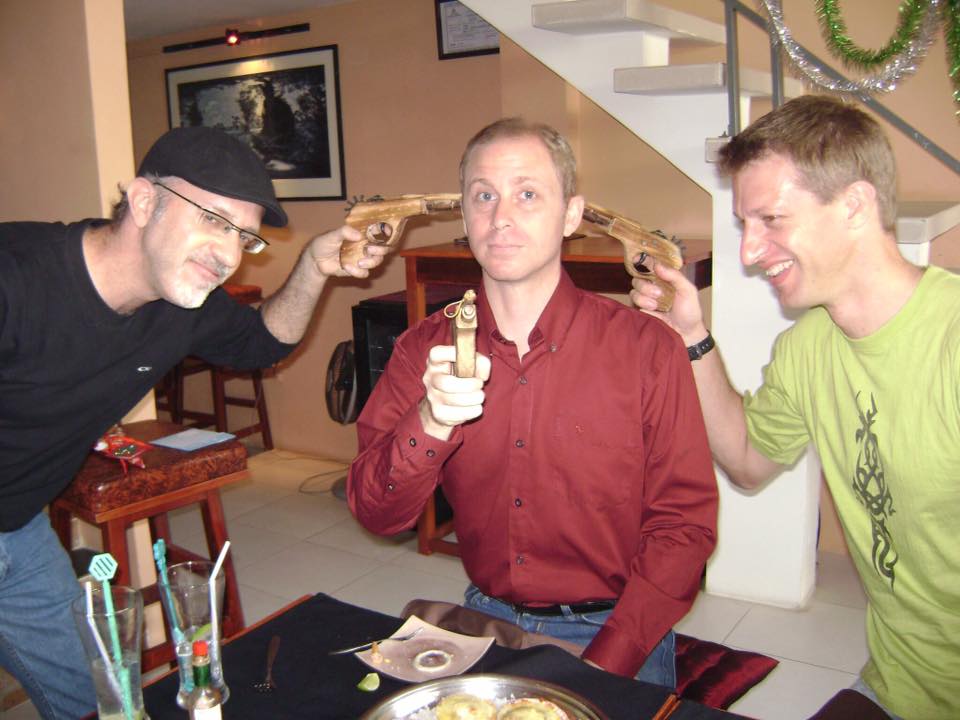
Most people take the ebb and flow of life in Cambodia for granted; not Steve. One evening we were having dinner on the riverside and one of thbook seller children stopped asked if we wanted any photocopied books. Steve patiently spoke with them and unpacked just how they worked, how they got paid and what their family situation was. The kids were amused and charmed by the barang who spoke such good Khmer, and Steve had another point of reference to work with.
As veterans of SEASSI we frequently touched base, especially when another classmate was in town. Steve had a strong insight into grass roots Khmer thought and opinions that was honed by years of living in-country with his ‘Khmer family’.
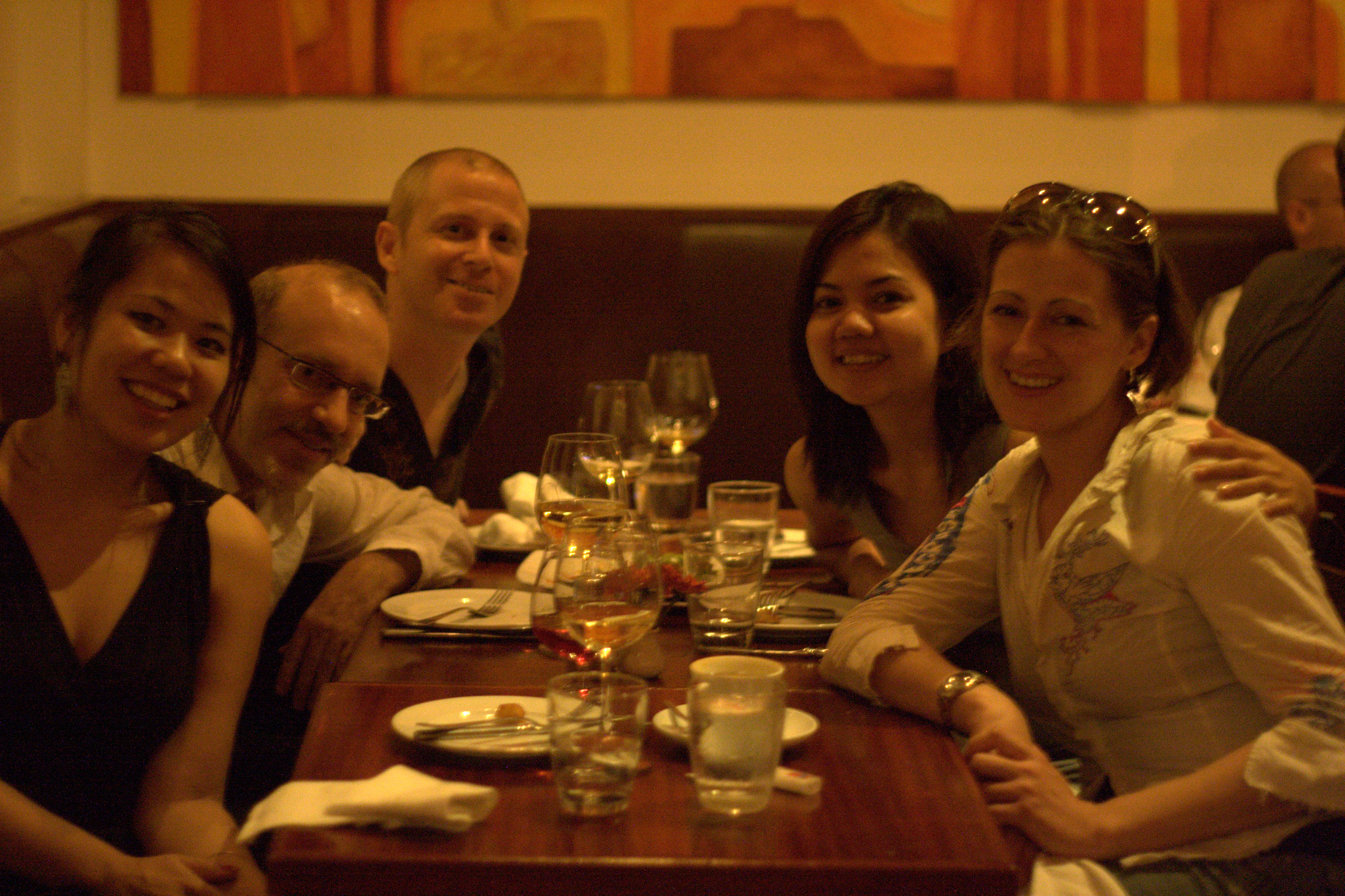
Keeping his nose to the grindstone and living cheaply served him well. When my family came to visit me, he hosted them for an evening at the apartments he was renovating on Street 178, across the street from ‘Friends’ NGO. (This task at times seemed more trouble than it was worth, but the apartments looked great.) This was done in the name of his Khmer family as it’s a challenge for foreigners to own property in Cambodia.
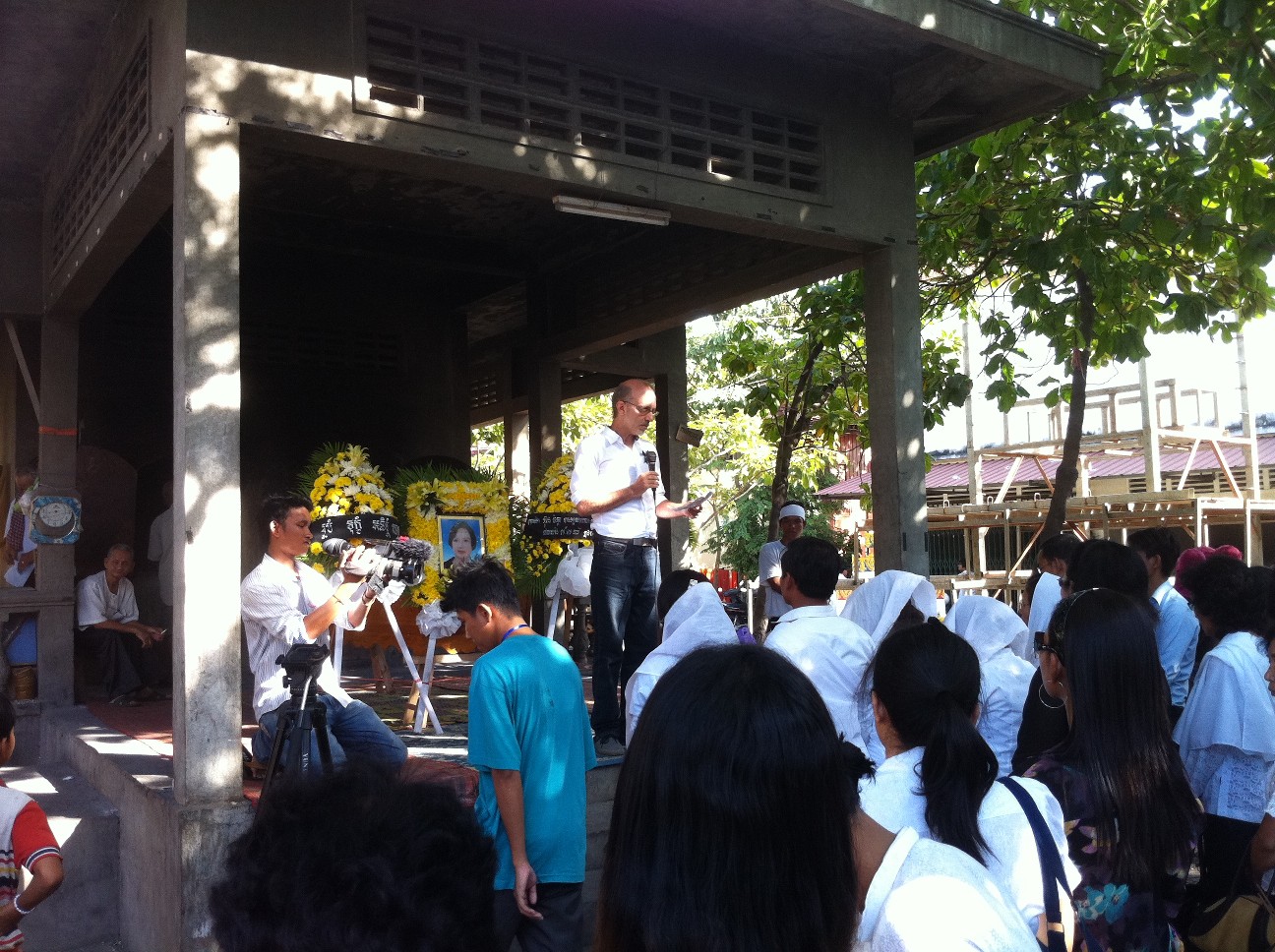
Steve returned to the USA in 2011 to look after his mother as she was passing. And when he returned to Cambodia he faced more sorrow when his ‘Khmer Mom’ passed (2012), he gave her an eloquent eulogy, in Khmer. Due to a number of family circumstances he decided to adopt her granddaughter – a challenging legal act for someone who is not a direct blood relative.
During recent years Steve had aimed to ‘go global’ and explore most of Southeast Asia (and the world), but often found himself being drawn back to Cambodia due to his skills and knowledge. He gifted us with entertaining travel tales.
In seeing the tributes and comments appear on Cambodia’s network of choice (Facebook) I’m reminded that Steve had deep roots in the Christian community. Steve was one of the ‘cool Christians’ who wouldn’t try to convert you; he’d rather talk about the Dhammiyeitra (interfaith peach march) or aspects of comparative Buddhist/Christian theology.
Steve was also a talented musician but extremely modest about it. His love of music included writing and recording his own.
Steve was an enthusiastic mentor and cheerleader for human rights, Khmer culture, and social change. He will be deeply missed. I have no doubt that he would urge us to both carry on with our work and to aim to be our very best selves.
As a testament to his effort I’ll be compiling a bibliography of reports and papers that he wrote / participated in / was cited in as well as memories at www.stevegourley.info . I welcome your help via john @ jweeks. net (Also, if you want to share text/images from this post, please ask first. They are (C) John Weeks and not for reposting unless given explicit permission.)
Buddhist and Christian ceremonies are slated for coming days. (Friday for Christian remembrance at Diakonia Center.)
(Thanks to Moses for this initial memorial; http://www.forevermissed.com/steve-gourley . Many are also posting on Steve’s Facebook page, and a group. https://www.facebook.com/CelebratingSteveG/)
For now I share this email Steve sent to his many friends when he left Cambodia in 2011. He didn’t know when he would return, so for him it marked the turning of a chapter. He should have the last word.
For months I’ve been thinking about what to write about as I leave Cambodia after first arriving in November of 1995. That was nearly 16 years ago – the majority of my adult life! A mind-blower, when I think of it.
I thought of writing about out some of the funny, moving and surreal experiences that have happened to me; or of the hard-earned successes and disappointing failures that occurred in both work and relationships; or how living so long in a no-longer-foreign country has changed me in so many positive and much-needed ways.
But I realize that it would be impossible to describe in words what this time has meant to me. I can only describe how I feel.
And I feel, more than anything else,
just
plain
grateful.
Actually, not just “plain”. Really, totally, overwhelmingly, cup-running-over grateful!
I therefore wish to share the following (severely curtailed) yet heartfelt thanks to (but not limited to) the following:
- The clearly divine Love that so unexpectedly led me here – and is just as unexpectedly leading me away. I can’t imagine how things would have turned out without the perfectly-timed providence, guidance and grace that I’ve received from Day One, through a fascinating and constantly-changing array of individuals and experiences.
- Each Cambodian adult, youth and child who welcomed and embraced me into their lives, families, homes and workplaces. One of the best decisions I have ever made is to live and work among your beautiful people, culture and country. I will never forget you – nor stay away for too long.
- Every expatriate who shared their unique culture, calling and friendship with me. Because of you, my life has been enriched beyond anything I could have imagined had I never left “home”.
- All of the employers and clients who kept me working nearly non-stop during the 15 years that actually I lived in-country. If I’ve made even a small difference in the lives of the children and youth of Cambodia, it’s because of your belief and trust in me.
- And last but not least, the staff of all the NGOs I worked for; the staff of all the coffee shops, restaurants, nightclubs, cafes, bookshops, market and street stalls that I frequented around Phnom Penh; and all of my neighbors around my little flat near the Mekong.
I learned more about Cambodian culture from you than anyone, and simply enjoyed sharing so many wonderful slices of life with you. Whenever anyone asked me what I liked best about Cambodia I always said “the people!”.
And by that I always meant YOU.

Jinja
There are 1,217 Posts and 666 Comments so far.