The Mystery of the Missing Middleman
Nov 15th, 2012 by Jinja
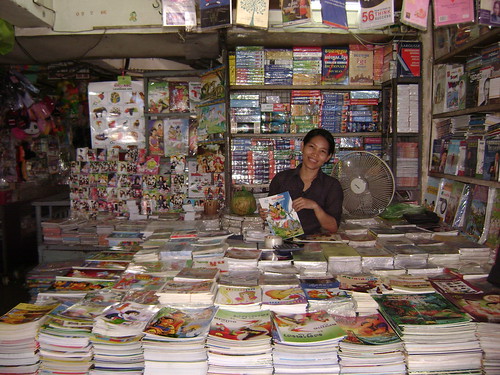
Above: book seller at Phnom Penh’s Psar O’Russey.
Some thoughts following on from Jason Dittmer and Katherine Brickell’s commentary on Cambodian comics copyright.
(You might want to read these links first.)
http://siewphewyeung.org.kh/newsprint-comics-at-psar-orussey/
In Cambodia’s 1980s, the boom in narrative comics unfolded in an informal economy. That meant some artists printed and published themselves (perhaps one of the purest exemplars of the DIY ethos). Others made different choices. Some would draw and produce their comics with ad-hoc screenprinters. This gray area was accepted so long as the material was approved by the Ministry of Information.
- Some authors, such as Sin Yang Pirom and her original teacher, Uth Roeun, never authorized reprinting. (Uth Roeun’s works currently on sale definitely qualify as ‘pirated’.)
- Some creators would (after several editions) sell their originals to a middleman.
- And some would produce directly for a middleman/publisher.
When speaking to Em Satya during the production of ‘Flower of Battambang’, he noted with a hint of chagrin that after 2 or 3 printings, he had sold his earlier work to middlemen. This was a handshake deal. Did this grant the middleman right to own and reproduce the comics in perpetuity?
As for the cartoonists who produced their works directly for middlemen/publication (Im Sokha, Or Yuthea, Hul Sophon), it resembles a work-for-hire situation – minus the contract. In a ‘socialist’ economy, articulation of intellectual property rights existed in law, but were not geared towards addressing the hothouse flower that was the 80’s comics market.
Once the bubble popped, authors found that their works were being reprinted – in volume and being sold to a new generation of young readers. Individual creators could not compete with printing of comics on an industrial scale. And so comics were reprinted again and again, with the strongest sellers slowly being winnowed out as readers gravitated towards more professionally printed materials such as color storybooks and translated color Thai comics.
I’ve interviewed comic artists, conferred with booksellers, and participated in numerous conversations with publishers, printers and librarians. But one voice missing from this evolving, intermittent conversation is that of the ‘middleman’.
It’s not been for lack of trying. Lim Santepheap, co-founder of Our Books, has tried several times to learn about the operations of comics printers. I’ve asked booksellers and politely been turned away.
What can we speculate? They are probably in it for their own enthusiasm, they’re surely not in it for the slim profits. They are likely continuing to operate simply because they’ve never had competing editions. The reprints provided by middlemen have been a boon for archivists, but a bane for the production of new independent work.
Are they ‘pirates’ as Dittmer and Brickell suggest? I doubt they consider themselves to be such.
Hopefully, the cartoonists of the 1980s bubble can reclaim copyright to their comics under Cambodia’s expanding definitions (and enforcement) of intellectual property. Until then, there’s a fascinating page of comics history that remains undrawn, waiting for a proper, nuanced delineation.