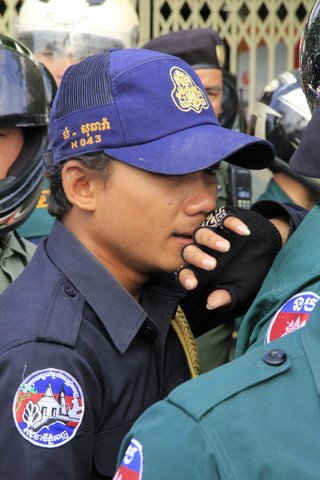
“He is crying while seeing children begging to go to see their mothers” Cambodian Legal Education Center: [Photos]
Regardless of how people may feel about how this issue played out as a protest & in the media, it’s good to see families reunited.
More: just Google “Boeung Kak“.
Returnees often find themselves discriminated against by USA citizens, expatriates, and Cambodian nationals. Many don’t have a working knowledge of Khmer, finding themselves trapped between two cultures – and unemployable. I don’t think deportation is a particular gift to Cambodia. Nor is it a workable solution for crime prevention/reduction. I believe the USA’s process for selecting and deporting Cambodians is quite hit-and miss, warranting review and revision.
Kosal has viewed his deportation as a second chance. He’s been a featured speaker at TEDxPhnomPenh and numerous local events.
Earlier this year he made an appearance highlighting returnee issues in a video submitted to The White House’s ‘My Asian Americana’ competition.
Invited to represent Cambodia in London’s ‘Poetry Parnassus‘, he left for the UK this last weekend after a highly-promoted gig at Pontoon Club.
At the airport, the same country that had invited Kosal stopped him and detained him. (Stages of this were documented by filmmaker Masahiro Sugano.) Kosal ended up being held at Colnbrook Immigration Removal Centre – one of the very facilities he was originally scheduled to perform at.
A day later, he is out, though his passport has not yet been returned. (‘Thank you’ video below).
It’s a pretty prestigious gig to perform at a cultural offshoot of the Olympics.
I’m guessing Kosal had his act buttoned down, this is not an opportunity he’d want to mess up.
What I’m wondering: A: Did the UK organizers have their act together in clearing his entry?
Or B: (Less likely) did Kosal knowingly or unwittingly break the law entering the country?
One thing’s for sure: he’ll get a story out of it. I’ll leave it to readers to make up their own minds.
The Cambodian Space Project is doing a fundraiser for BuckHunger soup kitchen!
Sounds like a fun event all around.
Buck Hunger is going like gangbusters to provide free food on a very simple model.
One recommendation that would make the whole operation more palatable: if the organization targets children, I’d be a lot more enthused if it was a registered ‘ChildSafe‘ organization. Individual and large-scale donors could give with even greater confidence.
If BuckHunger can get this accreditation as a part of their menu of future activities? That’d ROCK. : )
I spent most of my time at #SketchSaturday yesterday, while most of the focus seemed to be on TEDxPhnomPenh. The event had been heavily promoted by the US Embassy, the Phnom Penh Post, and business/NGO partners.
I did keep an eye on the Twitter chatter emerging that day, and was looking forward to seeing the video collations down the road.
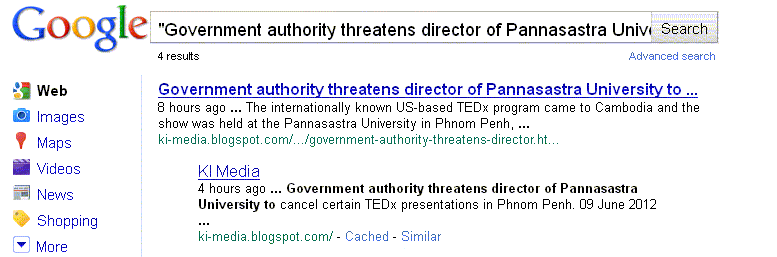
Later in the day, a post by KI-Media claimed that the director of Pannasastra University had been threatened regarding TEDxPP content. (The director has publicly denied this was the case.) This was flung to and fro on Twitter.
Due to KI-Media’s hyperbole and overt racism, I’m not an avid reader. (It’s unofficially blocked by most Khmer internet service providers.) In Cambodia’s convoluted media environment, the site does occasionally break/collate news that can’t be found anywhere else.
Just a few hours after the post went up, it was deleted, presumably at the request of the event organizers. (Above is a screen shot of the cached headline; the text portion of it still resides on KI-Media’s Facebook page.)
While I didn’t have the opportunity to take a screen shot of the blog post, I did download the two MP3s accompanying it for later listening – which are available here in mixed English and Khmer.
#1[MP3] & #2[MP3]
Far from censorship, the discussion seems more of a assessment about what content is acceptable in a public forum, by the different parties involved – community members, event organizers, and venue owners. This seems much closer to an issue debated in numerous BarCamps and blogger meetings – the issue of pragmatic self-censorship. In this case, presenting content related to the ‘Boeung Kak 15‘.
This Sunday TEDxPP released an “Official Statement on Yesterday’s Banned Talk” via their Facebook page.
After a few hours it was deleted (image from Google Cache), and a ‘Note on Removed Content’ was added to the TEDxPP site. (See postscript below.)
or: “We Lost The Lake, But Can We Free The Fifteen?”
In 2007 numerous advocates were concerned about Phnom Penh’s Boeung Kak lake. It was being filled in with sand, yet actual information about the company doing it was very hard to find. Unlike some communities facing eviction, this was a very diverse one, including a small tourist hub and a fair number of middle-class folks who really hadn’t expected to see such a drastic change.
Updating it was slow going. Most Cambodian advocacy NGOs are hestiant to embrace social media; they’re usually too busy dealing with crises at hand to consider a media strategy. Much less commit resources to putting information online. The end result? Usually it’s delegated to an intern.
Over the years Boeung Kak wasn’t ‘saved’, but filled in. After years of spotty and incomplete updating, the site finally seems to have found its groove. (Though I would caution them about their ‘cut and paste’ approach of using news articles in total.) I’m particularly impressed that ‘Save BK’ has begun including news directly in Khmer Unicode.
Showing how much can change in a few years: the lake is now full of sand. Fifteen Boeung Kak activists were taken to jail in a snap trial. Within a week, there was a blog: ‘Free The Fifteen’ (English and Khmer), a twitter account and a Facebook group.
Roughly one percent of Cambodia uses the internet on a regular basis. But it’s a very influential one percent. In the intervening years between the establishment of ‘Save Boeung Kak’ and ‘Free The 15′, young Cambodians have become addicted to the internet, particularly via Facebook. This has resulted in a much more web-savvy community over a very short period.
Here’s hoping that we will see a robust and civil discussion of issues on the internet in Cambodia, rather than censorship. Cambodia has an opportunity to set an example as a country with a high degree of free speech, compared to its more heavy-handed neighbors.